If you want to cook Italian food that actually tastes like Italy, it starts before you ever turn on the stove. These are the five pantry essentials I keep stocked at all times — the ingredients and tools that show up in almost everything I make, and the ones I’d tell any home cook to prioritize first.
This post contains affiliate links. If you click through and make a purchase, I may earn a small commission at no extra cost to you.
Thank you for supporting The Amore Life!
It Starts at the Pantry
There’s a reason the same Italian dishes taste so different from kitchen to kitchen. Technique matters, sure. But more often than not, the gap comes down to what’s in the pantry before anything hits the pan.
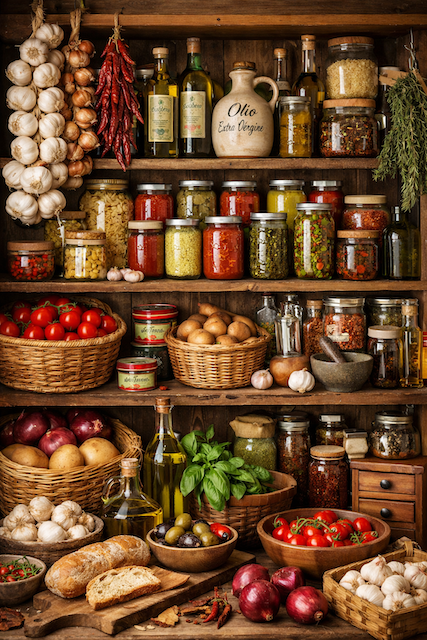
I’ve been cooking Italian food at home for a long time — long enough to know which ingredients are worth going out of your way for and which ones you can grab anywhere. Some of these I pick up at the local grocer like Stop & Shop or Fresh Market. Some require a trip to Whole Foods, DeCicco’s, Uncle Giuseppe’s or Eataly. A couple I order online. But all five of them live in my kitchen permanently, and I notice immediately when one of them runs out.
These aren’t exotic or complicated. They’re the fundamentals — the things that quietly elevate everything you make without asking for much in return.
1. Extra Virgin Olive Oil — Buy Certified, Buy Italian
Not all olive oil is created equal, and this is one area where the label genuinely matters.
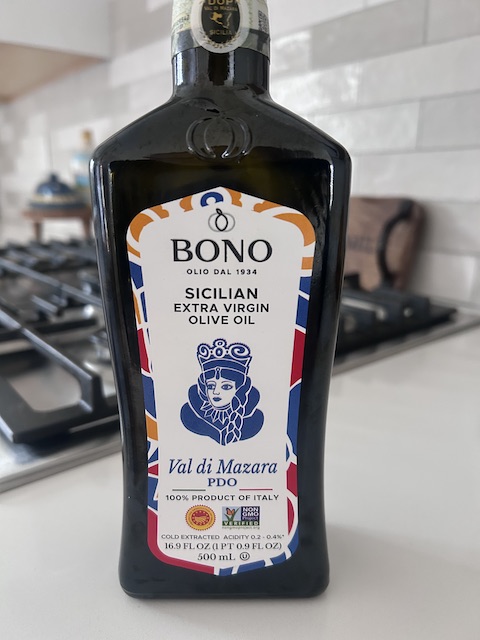
My go-to is Bono Sicilian Extra Virgin Olive Oil PDO Val di Mazara — a family-operated Sicilian producer that has been pressing olives since 1934 and accounts for the majority of PDO certified Val di Mazara oil produced in Italy. The PDO certification matters: it means the olives were grown, harvested, and bottled exclusively within a protected region under strict government oversight. You’re not guessing at origin. You know exactly what you’re getting.
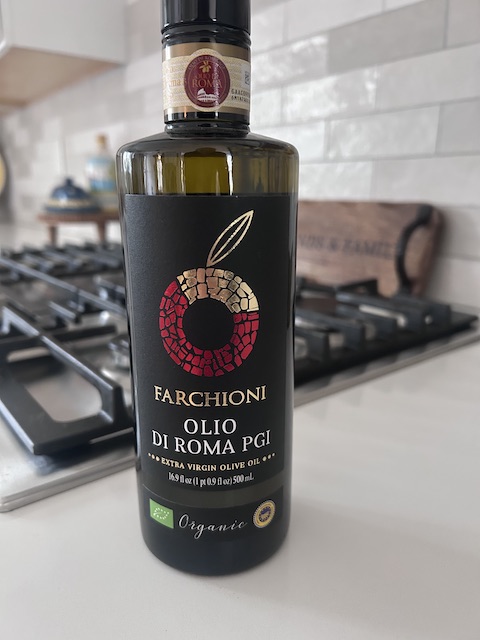
When I can find it, I also reach for Farchioni Olio Di Roma PGI — a little harder to track down but worth the effort, especially in organic form.
For everyday cooking, Bono is my workhorse — it holds up beautifully to heat. For finishing and dipping, I lean on whatever exceptional single-estate bottle I’ve picked up at Eataly most recently. Those tend to be more delicate and expressive, the kind of oil you pour over a finished pasta or a piece of burrata and let speak for itself. Giada De Laurentiis also has her own line worth trying if you want something more readily available online.
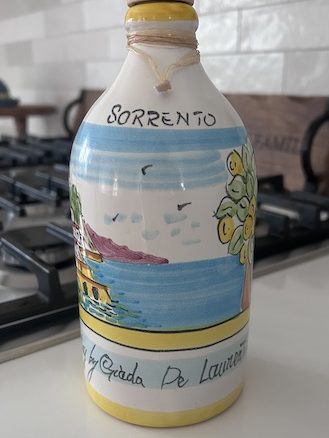
The one rule: look for PDO or PGI on the label. If it isn’t there, keep moving.
📍 Find Bono at Stop & Shop and Whole Foods. Specialty bottles at Eataly NYC. Both also available on Amazon.
2. Pasta — The Brand Matters More Than You Think
Pasta is one of those ingredients that looks interchangeable on the shelf and isn’t.
My everyday brand is Rummo. Founded in Benevento in 1846, Rummo uses a slow-processing method that produces pasta with real texture — the kind that holds its shape, absorbs sauce properly, and cooks to a genuine al dente without falling apart or going gummy. It’s widely available, sometimes on sale, and never disappoints. When I want to mix things up, La Molisana, Rustichella d’Abruzzo, and Sapori Di Casa are all excellent options worth exploring.
But the pasta conversation in my house goes deeper than that, because several members of my family — my in-laws and my youngest daughter — have Celiac disease. Cooking for a mixed table used to mean two separate pots and a constant reminder that someone was getting a lesser version of the meal.
Massimo Zero changed that entirely. I mean it when I say no one at the table can tell the difference. It doesn’t fall apart. It doesn’t turn to mush. You can cook it al dente and it holds — something most gluten-free pastas simply cannot do. When I make carbonara or a Sunday sauce and I’m cooking for the whole family, Massimo Zero is what goes in the pot. Rummo also makes a solid gluten-free line if you can’t find Massimo Zero, but Massimo Zero is the gold standard.
Both are best ordered online — Amazon carries Rummo’s gluten-free line, and Massimo Zero ships directly.
3. Canned Tomatoes — D.O.P. or Nothing
This is the one where I have zero flexibility.
If the label does not say D.O.P. San Marzano, I put it back on the shelf and keep looking. That designation — Denominazione di Origine Protetta — means the tomatoes were grown in the volcanic soil of the Agro Sarnese-Nocerino region near Naples, under strictly controlled conditions. The flavor is fundamentally different: sweeter, less acidic, with a depth that no regular plum tomato can replicate. Imitations exist everywhere. The certification is the only protection you have.
For whole tomatoes — which I prefer for Sunday sauce — I buy D.O.P. San Marzano, de-seed them as much as I can by hand, and then crush them by hand directly into the pot. That step alone makes a noticeable difference in texture. No blender, no food processor. Hands.
For passata, my go-to brands are Pomi, Mutti, and Riolfi. When I’m making lasagna, I typically use both — a passata as the base and whole D.O.P. tomatoes layered in for texture and body. Westport Fresh Market carries a wider range of brands than most local grocers if you want to explore beyond the standards.
One more thing: I never buy jarred sauce. Never. Except once — I tried the Carbone Vodka Sauce and I understood immediately why people lose their minds over it. That one earned a permanent exception.

📍 Pomi and Mutti at most major grocers. Wider selection at Westport Fresh Market and Whole Foods.
4. Pantry Staples — Capers and Calabrian Pepper
Two things that quietly transform everything they touch.
Capers are non-negotiable. I always buy non-pareil — the smallest variety, packed in olive oil rather than brine, with a cleaner flavor and better texture. I don’t lean hard on any specific brand here. Whole Foods 365 is perfectly fine. Whatever is non-pareil and packed in oil is what I grab. Capers go into chicken piccata, pasta puttanesca, salads, sauces — they add a bright, briny punch that you can’t replicate with anything else.
The more interesting evolution in my pantry lately has been swapping standard crushed red pepper for crushed Calabrian pepper. On paper they seem interchangeable. In practice, the dishes just taste better with Calabrian. There’s more complexity in the heat — something earthy and fruity underneath the spice that standard red pepper flakes don’t carry. I can’t always explain why a dish tastes more finished, more alive. I just know it does. More love in there, as I like to say.
Calabrian pepper is becoming easier to find — Whole Foods and specialty grocers typically carry it, and it’s widely available on Amazon. Once you make the switch, going back feels like a step backward.
5. Kitchen Tools — The Three I Cook With Every Day
Great ingredients deserve great tools. Three pieces of equipment that have earned a permanent place in my kitchen:
Lodge Cast Iron Skillet — My cast iron pan is fifteen years old and it only gets better with age. I bought it originally to sear steaks on my outdoor grill. It made its way into the kitchen and never left. Pancetta for carbonara, chicken cutlets, caramelized onions, filets, sauce — it does all of it. Cast iron holds heat evenly and builds a sear that no other pan in my collection can match. Lodge is the brand I trust and the one I’d recommend to anyone starting out. It’s reasonably priced, virtually indestructible, and improves with every use.
Le Creuset Dutch Oven — I came to the Dutch oven late and immediately understood what I’d been missing. The difference it makes for anything that needs to simmer low and slow — Sunday sauce, braised meats, soups — is significant. The heavy lid traps moisture perfectly, the enameled interior cleans easily, and the even heat distribution means you’re not babysitting the pot every ten minutes. The Le Creuset is an investment, but it is a genuine game changer.
John Boos Cutting Board + Cutco Knives + Acacia Wooden Spoons — The cutting board and knife situation matters more than most home cooks realize. I use John Boos cutting boards — thick, solid, and built to last. My Cutco knives came from a neighbor’s kid who was selling them over the summer, and I’ve never regretted that purchase. Sharp, well-balanced, and they’ve held up for years without issue. And switching to acacia wooden spoons was one of those small changes that quietly improved the experience of cooking — better feel, better heat resistance, better everything. Details like these add up.
The Through Line
None of these items are complicated. They’re not hard to find. But each one represents a choice to take the cooking seriously — to start with the right foundation before the pan ever hits the flame.
PDO certified olive oil. Slow-processed pasta. D.O.P. San Marzano tomatoes. Calabrian pepper. A cast iron pan that has fifteen years of meals cooked into it. That’s the pantry. Everything else follows.
What’s the one Italian pantry staple you can’t cook without? Drop it in the comments — I’m always looking to add something new to the shelf.